

Whether you're an engineer, quality manager, or someone responsible for compliance, you've likely come across calibration certificates. But what exactly do they mean, and what should you be looking for?
In many cases, calibration certificates are ordered simply to meet compliance requirements and then filed away for audits without ever being reviewed in detail. But these documents contain valuable information about the performance of your instruments, including whether they’re still within tolerance and how confident you can be in the measurements the instruments are taking.
This blog explains:
- what a calibration certificate is,
- what information it should include,
- how to interpret a calibration certificate, and
- why accreditation, uncertainty, and traceability really matter.
Whether you're managing measurement instruments or preparing for an audit, this guide will help you make informed decisions and avoid common pitfalls. /
Key takeaways
- A calibration certificate is the documented result of a calibration
It shows how your instrument performed, including results, uncertainty, and traceability. - Accreditation increases confidence
ISO/IEC 17025 accredited certificates provide independently verified results. - Uncertainty and traceability are essential
They determine how reliable your measurement results really are. - Certificates don’t expire
Calibration intervals are defined based on usage, risk, and requirements. - Don’t ignore the data
Results and deviations can reveal drift, issues, and potential risks in your process.
Table of Contents
What Is a Calibration Certificate?
A calibration certificate is an official document that records the results of a calibration and shows how a measurement device performs against a reference standard.
The calibration certificate confirms whether the device is measuring accurately and includes information on traceability and measurement uncertainty.
Let’s start with a reminder of what calibration is: the documented comparison of a measurement device against a traceable reference device. The calibration certificate is the “documented” part of this definition, showing the results of the calibration.
If the errors found are too large when calibrating, the instrument might need adjusting before being calibrated again. Although adjustment is a separate process from calibration, it is often included in the calibration process.
A calibration certificate is typically issued by a calibration laboratory. In regulated or quality-critical industries, these certificates are essential for audits, compliance, and maintaining confidence in equipment. Depending on the type of lab, a certificate may be accredited or non-accredited.
Accredited and Non-Accredited Calibration Certificates
Calibration labs typically fall into two categories: accredited and non-accredited. While accredited and non-accredited certificates may include similar information, there are significant differences. An accredited calibration certificate is issued by a lab that has been independently assessed and approved according to ISO/IEC 17025, the international standard for calibration laboratories.
Non-accredited certificates can still be traceable, but the traceability, competence of staff, procedures, and measurement uncertainty have not been verified by a third party.
You can find out more about calibration laboratories and what to look for in this blog: How to choose a calibration laboratory.
What Information Does a Calibration Certificate Include?
While the content of a non-accredited calibration certificate may vary, an accredited certificate typically includes fairly standard information.
A calibration certificate typically includes:
- the name and contact details of the calibration laboratory
- a unique certificate number
- a customer identifier
- the calibration date and location
- details of the instrument that was calibrated (model, manufacturer, serial number)
- details of reference standards used
- information about the environmental conditions during calibration
- calibration data: the numerical results of the calibration (as found/as left data) – see the next chapter for more information
- a traceability statement
- a compliance statement (pass or fail)
- the names and signatures of responsible personnel
- the measurement uncertainty (for accredited calibration)
- the calibration procedures used (internal standard operating procedures)
- the accreditation body and scope (for accredited calibration)
Some certificates may also include correction factors, graphs, or notes on any adjustments or maintenance done.
How to Read an Accredited Calibration Certificate
Let’s take an example of one page from an accredited calibration certificate issued by the Beamex ISO/IEC 17025 accredited calibration laboratory, for a pressure module installed on a Beamex MC6 calibrator.
Here is a screen shot of one calibration data table in the certificate (with customer confidential information blurred):
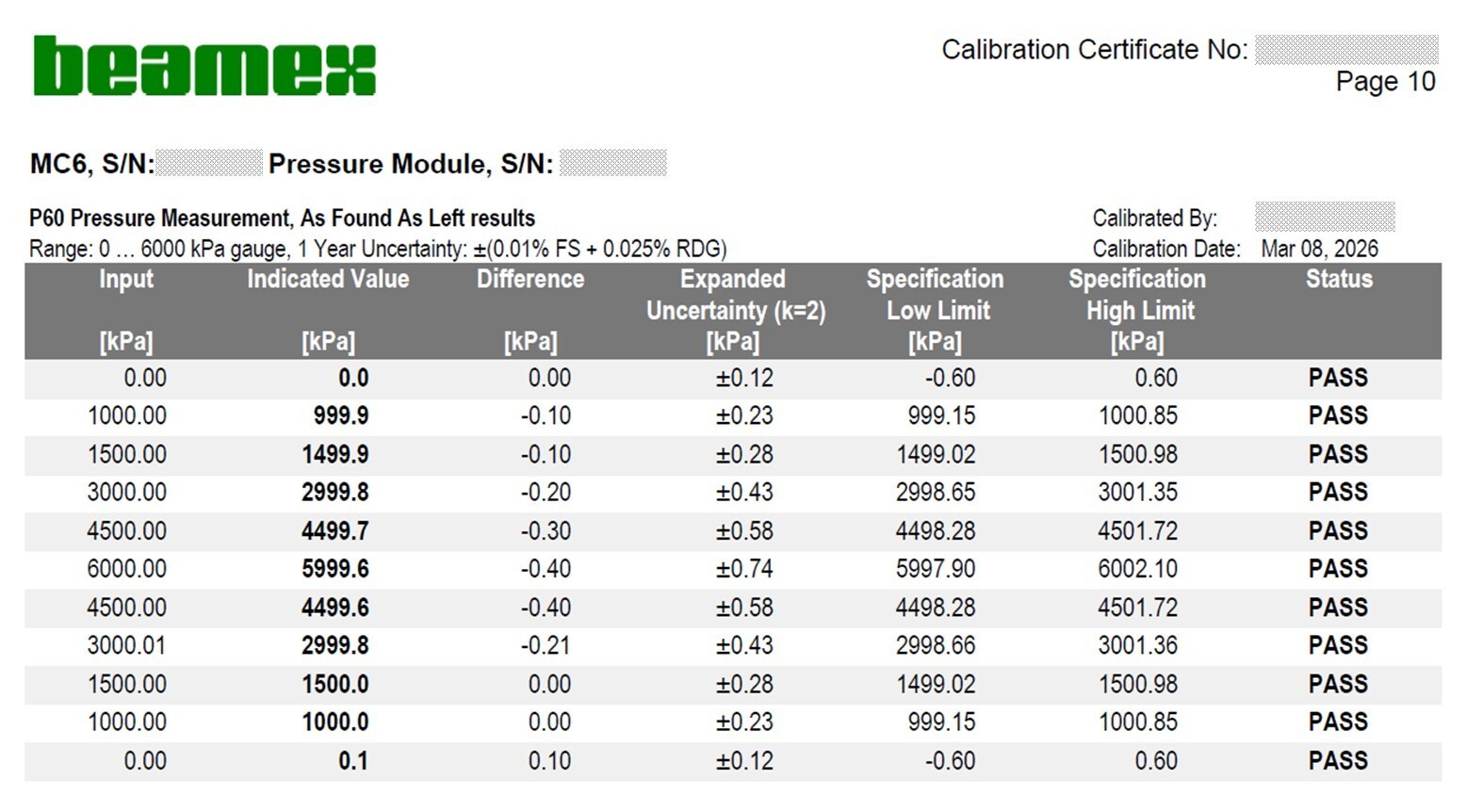 The top part of the page includes the Beamex logo, calibration certificate number, page number, the device calibrated and serial number, the module calibrated with serial number, a note that these results are as found and as left, the range and specifications of the module, the calibration date, and the name of the technician who performed the calibration.
The results columns include:
- Input = the pressure applied to the pressure measurement module by the reference standard
- Indicated Value = the indication of the device under calibration
- Difference = the difference between the input and the indicated value
- Expanded Uncertainty (k=2) = the calculated expanded uncertainty (with k=2, i.e. 2 sigma) separately for each calibration point
- Specification Low Limit = the low limit of the equipment’s 1-year uncertainty specifications
- Specification High Limit = the high limit of the equipment’s 1-year uncertainty specifications
- Status = an indication of whether the point is a pass or a fail, taking into account the difference and the calibration uncertainty
Understanding Measurement Uncertainty
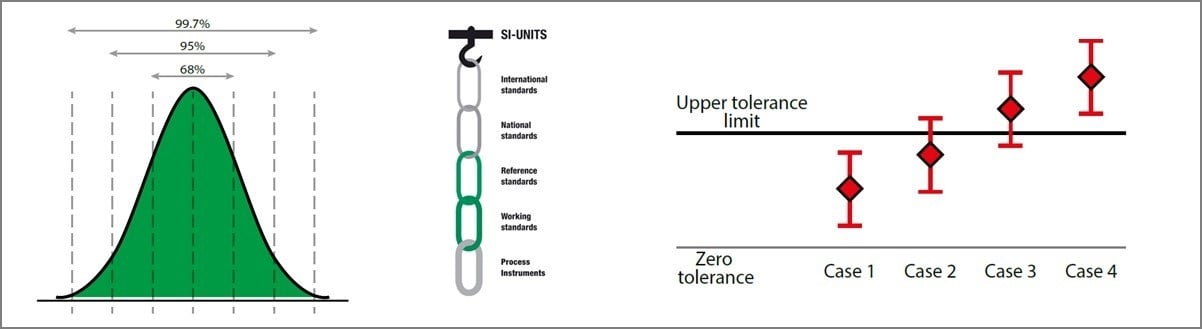
Measurement uncertainty is the quantified “doubt” about the measurement result, giving you essential context for the calibration data. It tells you how confident you can be in the results of the calibration and is crucial for determining whether the instrument meets its specifications.
Without knowing the measurement uncertainty, even perfect-looking results can be misleading. Accredited labs are required to calculate and state the measurement uncertainty.
For more information on calibration uncertainty, please read the blog: Calibration uncertainty for dummies.
Understanding Traceability
Traceability means that the measurement results can be linked to national or international standards through an unbroken chain of calibrations, each with known uncertainty. For example, a pressure calibrator might be calibrated using a reference that is itself calibrated by a national metrology institute like NIST (US) or UKAS (UK).
Only accredited labs are regularly audited by independent accreditation bodies to verify this traceability chain. Non-accredited labs may claim traceability, but without independent verification, the reliability of their claims can vary.
For more information on traceability, please read the blog: Metrological Traceability in Calibration – Are you traceable?
Calibration Certificate Validity and Calibration Interval
Calibration certificates do not have expiration dates. Instead, the user of the device in question is responsible for defining an appropriate calibration interval based on the device’s usage, criticality, manufacturer recommendations, and quality system requirements.
If you’re unsure about calibration intervals, our article will help: How often should instruments be calibrated?
The Digital Calibration Certificate (DCC)
The DCC offers a smarter, more secure alternative to traditional paper or PDF calibration certificates. DCCs enable better automation and easier data integration as well as eliminating manual errors in calibration workflows.
A DCC is machine-readable, tamper-evident, and allows for seamless calibration data flow across systems. Learn more in Digital Calibration Certificate (DCC) – What is it and why should you care?
Calibration management Software
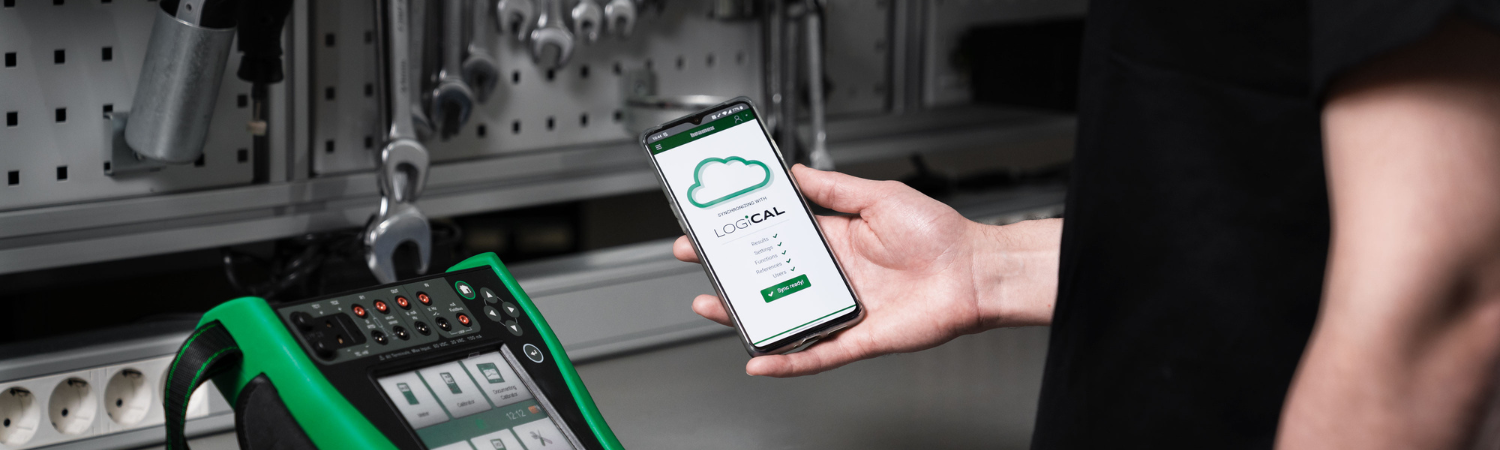
Managing calibration certificates manually can be time-consuming and error-prone. Calibration management software automates certificate generation, storage, scheduling, and audit preparation, reducing workload and improving compliance.
What If Your Calibrator Fails? Understanding Reverse Traceability
While a calibration certificate confirms the accuracy of your instrument at the time it was calibrated, it is equally important to consider what happens if your device fails a calibration, especially if it is a reference calibrator used to calibrate other instruments.
If a calibrator is found to be out of tolerance during a scheduled calibration, you need to analyze the magnitude of the error and determine how long the device may have been inaccurate. This is where reverse traceability comes into play. Reverse traceability is the process of checking past records to identify which instruments were calibrated using the faulty calibrator and assessing whether those calibrations can still be considered valid.
Depending on the level of deviation and how critical those instruments are to your process, you may need to recalibrate the affected instruments. In high-risk or regulated industries, an inaccurate instrument could even lead to product impact assessments or recalls if quality or compliance was compromised.
Calibration management software that includes reverse traceability reporting can be extremely helpful in this situation because it enables you to quickly identify affected instruments and take appropriate corrective action.
Proper documentation, reliable calibration scheduling, and an understanding of traceability help ensure that even in these situations, you can respond quickly and confidently.
Beamex Calibration Services and Certificates
Beamex offers ISO/IEC 17025 accredited calibration services. Our certificates include full uncertainty statements, traceability, as-found/as-left data, and adjustments if needed. Because we are the manufacturer, unlike third-party labs, our procedures and uncertainties are optimized for the full range of Beamex equipment.
When choosing a calibration provider, remember that calibrating a device such as a Beamex MC6 family calibrator with multiple accurate ranges can be a challenge for any calibration laboratory. The provider must pay careful attention to the uncertainty for each range. We’ve seen many cases where the uncertainty is not good enough.
Before sending any calibration equipment to a calibration laboratory, make sure they can provide sufficiently low measurement uncertainty. The calibration capability of an accredited laboratory is described in its Scope of Accreditation, which specifies the best achievable measurement uncertainties for each range. You can find the Beamex laboratory’s Scope of Accreditation on our calibration services page.
The best way to make sure your equipment stays reliable and audit-ready is to protect it with a Beamex Care Plan. These plans include calibration, repairs, updates, and technical support all in one package.
Conclusion
Calibration certificates are more than just documentation; they are essential proof of your equipment’s reliability and compliance. Understanding what calibration certificates include (or don’t include), knowing how to interpret the information, and understanding why traceability and uncertainty matter will help you make smarter decisions for quality and risk management.
To learn more about Beamex calibration services or to see a sample calibration certificate, contact us or take a look at the calibration services section on our website.
Please contact our experts to discuss your calibration requirements.
.png)
.png)







.jpg)

Discussion